

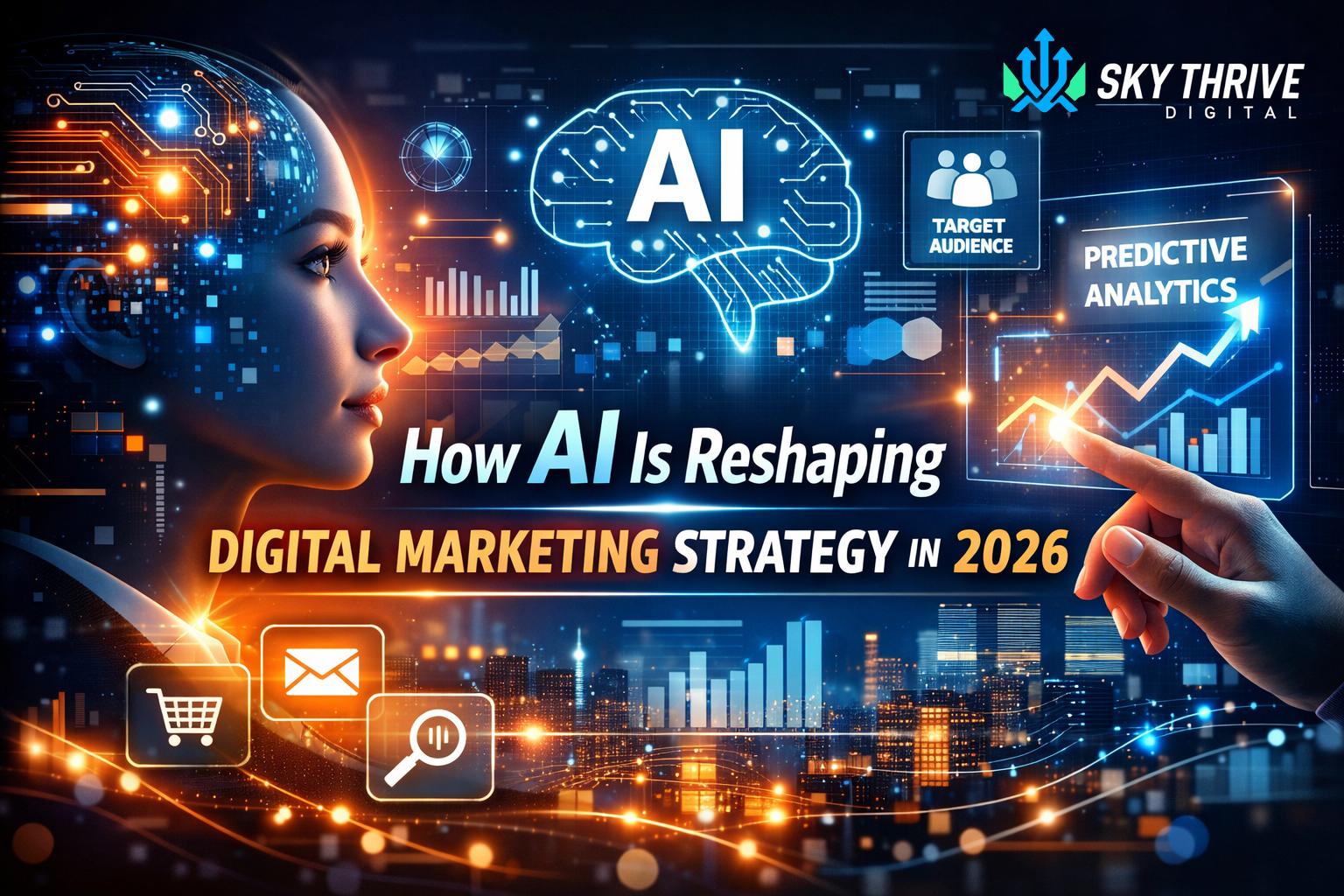

Artificial Intelligence is no longer an experimental add-on in marketing—it has become the backbone of modern digital strategy. By 2026, AI has moved far beyond chatbots, basic automation, or isolated tools. Today’s most effective brands operate within AI-first marketing ecosystems, where data, creativity, media, and performance optimization are tightly connected through intelligent systems.
For growth-focused businesses and agencies alike, the question is no longer whether to use AI, but how strategically it is integrated into decision-making, execution, and measurement. This shift is fundamentally redefining how digital marketing strategies are built, scaled, and sustained.
The Evolving Role of AI in Digital Marketing (2026 Perspective)
In earlier years, AI was often deployed in silos—one tool for copywriting, another for analytics, another for ad optimization. In 2026, this fragmented approach has been replaced by integrated AI workflows that connect the entire marketing funnel.
AI now functions as a strategic co-pilot, continuously learning from:
- Customer behavior across channels
- Real-time campaign performance
- Market trends and competitive signals
- Historical conversion and revenue data
Instead of reacting to reports after the fact, marketers can proactively shape strategy using predictive insights and real-time intelligence. This evolution has turned AI into a decision engine, not just a productivity enhancer.
Strategic Impact: How AI Is Transforming Marketing at Scale
1. Intelligent Marketing Automation
Traditional automation followed predefined rules. AI-driven automation adapts dynamically.
In 2026:
- Campaigns self-adjust budgets based on predicted ROI
- Email and CRM workflows evolve in real time based on user intent
- Lead scoring models continuously recalibrate based on conversion likelihood
This allows teams to scale faster while maintaining precision—without increasing operational complexity.
2. Hyper-Personalization at Every Touchpoint
AI enables personalization at a level that manual segmentation could never achieve.
Modern AI systems analyze:
- Browsing behavior and micro-interactions
- Purchase history and engagement depth
- Content preferences and timing patterns
The result is one-to-one marketing at scale—personalized landing pages, dynamic ad creatives, and context-aware messaging that feels human, not automated.
3. Data-Informed Decision-Making (Without Data Overload)
AI doesn’t just collect data—it translates it into actionable intelligence.
Instead of dashboards filled with vanity metrics, marketers now receive:
- Clear performance narratives
- Predictive forecasts instead of historical summaries
- Recommendations prioritized by business impact
This empowers leadership teams to make faster, more confident decisions grounded in real business outcomes.
Practical Applications: AI in Action Across the Funnel
Campaign Optimization
AI continuously tests creative variations, audience signals, and placements to identify winning combinations. Poor-performing assets are deprioritized automatically, while high-impact elements receive increased investment.
This results in:
- Lower cost per acquisition
- Faster learning cycles
- More consistent performance across platforms
Advanced Customer Segmentation
AI-driven segmentation moves beyond demographics to behavioral and intent-based clusters.
For example:
- High-intent but price-sensitive users
- Repeat buyers with declining engagement
- New users likely to convert within a short time window
These insights allow marketers to design messaging and offers that align perfectly with each segment’s mindset.
Predictive Analytics for Growth Planning
AI models now predict:
- Conversion probability
- Customer lifetime value
- Churn risk
- Revenue impact of media spend changes
This shifts marketing from short-term execution to long-term growth engineering, where every decision is evaluated through a profitability lens.
Why This Matters to CMOs, Founders, and Agencies
For CMOs
AI offers clarity in an increasingly complex digital ecosystem. It bridges the gap between brand, performance, and revenue—allowing CMOs to align marketing strategy directly with business goals.
For Founders
AI-driven marketing reduces dependency on guesswork and accelerates product-market fit validation. It enables smarter budget allocation and faster scaling without burning resources.
For Agencies
Agencies that embrace AI-first frameworks move from execution partners to strategic growth advisors. The focus shifts from managing platforms to delivering measurable business impact.
However, the challenge lies in implementation—knowing which AI capabilities to trust, how to align them with brand strategy, and how to maintain transparency and control.
The Future Outlook: What Comes Next After 2026?
Looking ahead, AI will continue to evolve in three key directions:
- Autonomous Marketing Systems
AI will increasingly manage entire micro-campaigns end-to-end, with human teams focusing on strategy, creativity, and ethics. - Creative Intelligence
AI-generated content will become more emotionally intelligent, context-aware, and brand-aligned—supporting, not replacing, human creativity. - Privacy-First Intelligence
As data regulations tighten, AI will rely more on first-party data, modeled insights, and consent-based personalization—making strategy and data governance more critical than ever.
The brands that win will be those that balance innovation with responsibility.
How Sky Thrive Digital Aligns With the AI-First Marketing Era
At Sky Thrive Digital, AI is not treated as a shortcut or a trend—it is embedded into a tailored, results-driven marketing philosophy.
Our approach focuses on:
- Strategic AI integration aligned with business goals
- Certified expertise across performance marketing, SEO, analytics, and automation
- Human-led strategy powered by AI-driven intelligence
- Transparent reporting that ties marketing activity directly to revenue impact
We believe AI delivers its true value only when guided by experience, ethical frameworks, and a deep understanding of each client’s market.
Final Thoughts
AI is reshaping digital marketing in 2026 by transforming how strategies are designed, executed, and optimized. The shift toward AI-first workflows is not about replacing marketers—it’s about empowering them to operate with greater precision, creativity, and confidence.
For brands and agencies willing to evolve, AI represents not just efficiency—but a sustainable competitive advantage.
The future of digital marketing belongs to those who combine human insight with machine intelligence—and Sky Thrive Digital is built for that future.
